

Introduction:
Digital communication has become an important part of everyday life and business transactions. WhatsApp conversations, emails, screenshots, call recordings, photographs and other electronic records are increasingly relied upon in Indian courts to establish facts and support legal claims.
Such records can be relevant in criminal complaints, cybercrime cases, matrimonial disputes, employment matters, commercial litigation and financial recovery proceedings. However, their evidentiary value depends on their authenticity, relevance and compliance with the applicable legal requirements.
The Bharatiya Sakshya Adhiniyam, 2023 (BSA) recognises electronic and digital records as evidence, subject to the conditions prescribed by law. The objective is to ensure that digital material presented before a court is reliable and can be properly examined.
Can WhatsApp Chats and Screenshots Be Used as Evidence?
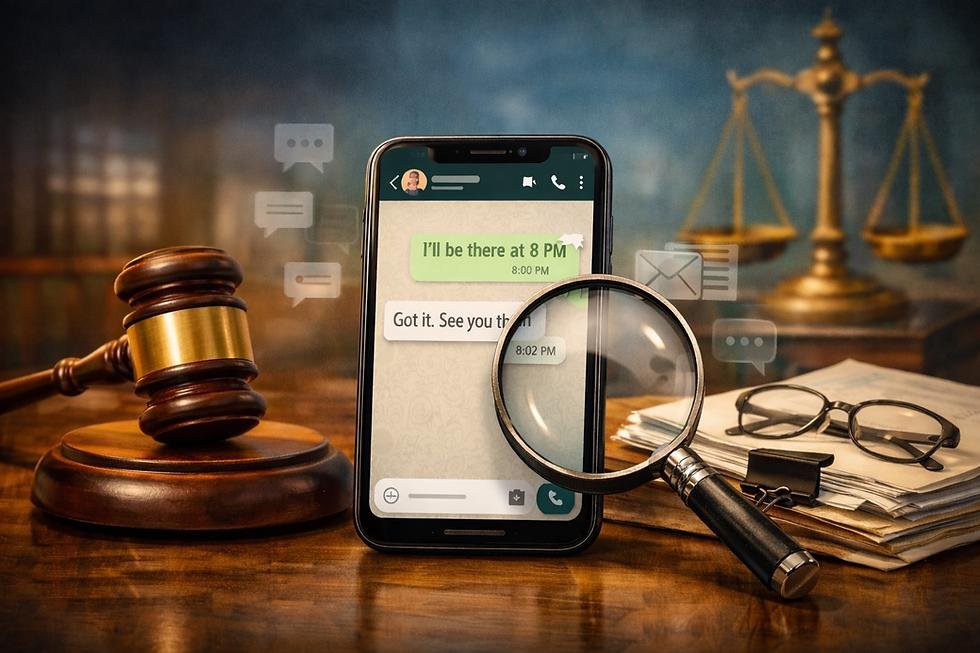
Yes. WhatsApp conversations and screenshots may be relied upon in court proceedings when they are relevant to the dispute and their authenticity is established.
For example, WhatsApp messages may help demonstrate repayment promises, business commitments, threatening communications, contractual discussions or other exchanges between parties.
However, a screenshot alone does not automatically establish who sent a message or whether the conversation is complete and genuine. Courts may examine the original device, surrounding communications, supporting records and other circumstances before assessing its evidentiary value.
Are Emails and Call Recordings Admissible in Court?
Emails and call recordings may also be relied upon as electronic evidence in appropriate proceedings.
Emails can be relevant in contractual disputes, employment matters, payment claims and business transactions. Call recordings may be relevant in cases involving alleged threats, admissions, harassment or disputed conversations.
The authenticity, source, completeness and relevance of such material remain important considerations. A recording or email should not be assumed to be conclusive proof merely because it exists in electronic form.
Supreme Court’s 2026 Decision on Electronic Evidence
In Pune Bar Association v. Union of India, W.P. (C) No. 599 of 2026, decided on 22 May 2026, the Supreme Court considered a challenge to the certificate requirements governing electronic records under the Bharatiya Sakshya Adhiniyam, 2023.
The Court upheld the constitutional validity of the prescribed requirements, recognising the importance of protecting electronic records against alteration and manipulation. It also considered the role of hash values and expert certification in establishing the integrity of digital material.
The decision highlights that electronic evidence must be handled carefully and presented in accordance with the applicable legal framework.
How Should Digital Evidence Be Preserved?
Anyone anticipating legal proceedings should preserve relevant electronic records in their original form wherever possible.
Important material may include:
- Complete WhatsApp conversations rather than selected screenshots.
- Original emails and relevant attachments.
- Call recordings and associated files.
- Photographs, videos and CCTV footage.
- Bank statements and payment confirmations.
- The original mobile phone or computer containing the records.
Avoid deleting messages, editing screenshots, altering recordings or unnecessarily forwarding files. Where authenticity is disputed, technical or forensic examination may be useful.
Why Legal Assessment of Electronic Evidence Matters
Improper collection, incomplete records or failure to follow applicable certification requirements may create difficulties when electronic evidence is presented before a court.
Whether you are relying on digital communications to support a complaint or challenging electronic material produced against you, the legal position should be assessed in the context of the facts and the nature of the proceedings.
Legal Assistance by Allies for Justice (AFJ)
At Allies for Justice (AFJ), we understand the growing importance of electronic evidence in modern litigation. Digital communications can play a significant role in criminal cases, cybercrime complaints, matrimonial disputes, commercial disagreements and financial recovery matters.
Our legal assistance includes assessment of electronic records, advice on evidentiary requirements, preservation of relevant digital material and legal representation in appropriate proceedings.
If WhatsApp messages, emails, screenshots or recordings are relevant to your legal dispute, obtaining appropriate legal guidance can help you understand how such material may be used or challenged.
Contact Allies for Justice (AFJ)
Website: www.alliesforjustice.com
Email: alliesforjustice.afj@gmail.com
Contact: 8527706198 | 8285728233
Allies for Justice (AFJ) – Advocates & Legal Consultants
Frequently Asked Questions
1. Can WhatsApp chats be used as evidence in Indian courts?
Yes. Relevant WhatsApp conversations may be used as electronic evidence, subject to applicable legal requirements and proof of authenticity.
2. Are screenshots sufficient to prove a legal claim?
Not necessarily. Screenshots may require supporting material to establish their source, authenticity and context.
Disclaimer: This article is intended for general legal information and awareness. It does not constitute legal advice or create an advocate-client relationship. The admissibility and evidentiary value of electronic records depend on the facts, applicable law and judicial assessment in each case.
