

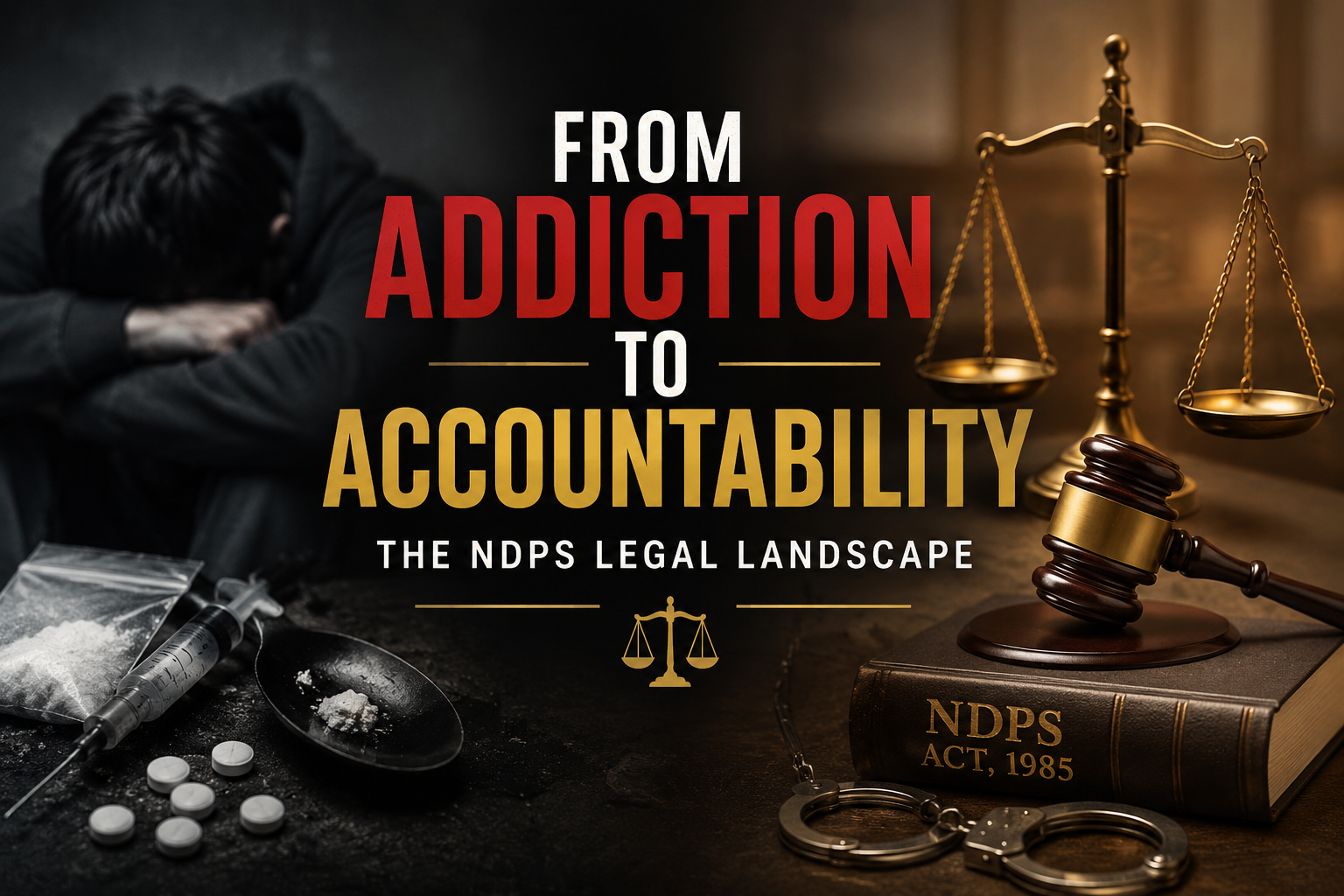
When Addiction Meets the Law — How Legal Guidance, Treatment and Due Process Can Make a Difference
Addiction can affect a person’s health, family, employment, finances and relationships. In some circumstances, it can also bring a person into contact with the criminal justice system.
When a person facing substance dependence becomes involved in a case under the Narcotic Drugs and Psychotropic Substances Act, 1985 (NDPS Act) or another criminal proceeding, the situation can become overwhelming for the individual and their family.
However, it is important to understand one fundamental principle:
Addiction does not mean that a person automatically loses their legal rights.
A person facing criminal allegations remains entitled to due process of law and appropriate legal representation. At the same time, the nature of the alleged offence, quantity involved, evidence, role attributed to the accused and applicable statutory provisions can significantly affect the available legal remedies.
At Allies for Justice – Advocates & Legal Consultants, we assist clients and their families in understanding the legal implications of such cases, evaluating the available remedies and developing an appropriate legal strategy based on the facts and evidence.
Understanding Addiction in the Context of Criminal Law
Substance dependence can sometimes be connected with offences involving possession, consumption, procurement, transportation, sale or other prohibited activities.
But every case is different.
A person alleged to be a consumer or an addict may have a very different legal position from a person accused of possession for commercial purposes, trafficking or operating a larger drug network.
Therefore, simply saying that someone is “addicted” is not enough to determine the outcome of a case.
The court may need to consider factors such as:
- The substance allegedly involved
- The quantity allegedly recovered
- The circumstances of the recovery
- The alleged role of the accused
- Whether possession is alleged and what evidence supports it
- Whether there are allegations of supply or trafficking
- The manner in which search and seizure were conducted
- Statements and other evidence relied upon by the prosecution
- Previous criminal history, where legally relevant
- Compliance with applicable procedural safeguards
- The stage of the proceedings
This is why individualised legal advice is important.
Does Addiction Excuse a Criminal Offence?
Not automatically.
Addiction itself does not provide a blanket defence against every offence under the NDPS Act.
However, Indian law does contain certain provisions that recognise treatment and rehabilitation in particular circumstances.
For example, Section 64A of the NDPS Act provides for immunity from prosecution in specified circumstances for an addict charged with an offence punishable under Section 27 or an offence involving a small quantity of narcotic drugs or psychotropic substances, where the person voluntarily seeks and undergoes medical treatment for de-addiction at a government-maintained or government-recognised hospital or institution. The statutory conditions must be satisfied, and the immunity may be withdrawn if the person does not complete the treatment.
This is an important provision, but it should not be misunderstood as a general immunity available in every NDPS case.
The applicability of Section 64A depends upon the precise offence, the quantity involved, the person’s legal status and compliance with the statutory requirements.
What About Treatment Instead of Punishment?
The NDPS Act also recognises treatment and rehabilitation in certain circumstances.
Under Section 39 of the NDPS Act, where an addict is found guilty of an offence punishable under Section 27 or an offence relating to a small quantity, the court may, subject to the statutory requirements and its assessment of factors including the person’s age, character, antecedents and physical or mental condition, direct release for medical treatment for detoxification or de-addiction instead of immediately sentencing the person to imprisonment.
This demonstrates an important aspect of the legal framework:
The law can, in appropriate cases, recognise rehabilitation alongside accountability.
But this is not automatic.
The court’s power is dependent upon the statutory conditions and the facts of the individual case.
Addiction, Criminal Allegations and the Importance of Evidence
In an NDPS case, the prosecution must establish its case in accordance with law.
Therefore, a defence cannot simply rely on the statement:
“The accused is an addict.”
A proper legal defence requires examination of the entire case.
This may include examining:
Search and Seizure
Was the search conducted in accordance with the applicable legal requirements?
Were the relevant safeguards followed?
Recovery
What exactly was allegedly recovered?
Where was it recovered from?
How was the recovered substance identified, sealed and documented?
Quantity
Is the quantity alleged to be small, intermediate or commercial under the applicable legal framework?
The quantity can have significant consequences for the applicable provisions and bail considerations.
Documentation
Are the seizure documents, samples, inventory, statements and other records consistent?
Chain of Custody
Has the prosecution properly accounted for the handling and movement of the alleged contraband and samples?
Statements and Other Evidence
What statements or other material are being relied upon?
Are there contradictions or procedural issues requiring examination?
Role of the Accused
Is the allegation one of consumption, possession, transportation, supply, financing or another form of involvement?
The legal strategy should be based on the actual evidence, not merely the accusation.
Bail in Cases Involving Addiction
A person facing an NDPS case may also need urgent advice regarding bail.
Bail considerations depend heavily on the offence alleged, quantity involved, statutory restrictions and the evidence available.
In cases attracting the restrictions under Section 37 of the NDPS Act, the statutory requirements for bail are particularly important.
Therefore, a person or family should not assume that addiction alone guarantees bail.
At the same time, the accused should not assume that being charged under the NDPS Act means that there are no legal remedies available.
A lawyer can examine:
- The sections invoked
- Quantity involved
- Recovery circumstances
- Search and seizure procedure
- Prosecution material
- Applicability of Section 37
- Previous criminal antecedents
- Medical or treatment-related circumstances
- Stage of investigation or trial
- Other legally relevant factors
and then advise on the appropriate course of action.
What Should a Family Do When a Person Is Arrested?
When a family member is arrested in a drug-related case, panic can often lead to poor decisions.
Instead, the family should focus on obtaining accurate information.
Immediately try to understand:
- Which police station or agency has registered the case?
- What FIR or case number has been assigned?
- Which provisions of law have been invoked?
- What substance and quantity are allegedly involved?
- Where and how was the alleged recovery made?
- Where is the accused currently being held?
- What is the present stage of the proceedings?
- What documents have been provided?
- Is medical or de-addiction treatment relevant to the person’s circumstances?
- What immediate legal remedy is available?
A lawyer should be consulted as early as possible so that the case can be assessed from the beginning.
Do Not Confuse Addiction With Trafficking
One of the most important distinctions in NDPS litigation is the difference between different allegations.
A person suffering from substance dependence may be accused of possession or consumption.
Another person may be accused of supplying or trafficking narcotic drugs.
These are not necessarily the same factual or legal situation.
The prosecution’s allegation must be examined carefully, including the evidence used to attribute a particular role to the accused.
A defence strategy should therefore be built around:
What happened?
What evidence exists?
What does the law require the prosecution to establish?
Were the applicable procedural safeguards followed?
Treatment and Legal Proceedings Can Exist Together
Seeking treatment for addiction does not necessarily mean abandoning legal rights.
Similarly, defending a criminal case does not mean that a person cannot seek treatment or rehabilitation.
In appropriate circumstances, legal strategy and rehabilitation efforts can operate alongside one another.
A family may therefore need assistance from more than one professional — including legal counsel and qualified medical or rehabilitation professionals.
Legal professionals deal with the legal process.
Medical and rehabilitation professionals deal with treatment and recovery.
Both roles are important and should not be confused.
How Allies for Justice Can Help
At Allies for Justice – Advocates & Legal Consultants, we understand that a drug-related criminal case can affect not only the accused but the entire family.
Our role is to help clients understand the legal position, protect their rights and navigate the appropriate legal proceedings.
1. Case Assessment
We begin by understanding the complete factual background.
We examine the allegations, FIR, relevant documents and available information to identify the legal issues involved.
2. Examination of Search and Seizure
In applicable cases, we examine the circumstances surrounding the alleged recovery and whether relevant statutory and procedural safeguards appear to have been followed.
This may involve reviewing:
- Search proceedings
- Seizure documentation
- Recovery records
- Sampling and sealing
- Statements
- Independent witnesses, where relevant
- Other investigation material
3. Bail Strategy
Where bail is legally available, we assess the applicable provisions and develop an appropriate bail strategy based on the facts, evidence and stage of the proceedings.
We assist with appropriate bail proceedings before the competent court.
4. Defence in NDPS Proceedings
We provide legal assistance in defending clients facing allegations under the NDPS Act, including matters involving possession, consumption and other alleged offences, depending on the facts of the case.
Our approach is evidence-based and focused on the specific allegations and legal requirements applicable to the matter.
5. Treatment-Related Legal Guidance
Where addiction and de-addiction treatment are relevant to the case, we explain the legal provisions that may potentially apply based on the facts.
This may include examining the relevance of provisions such as Sections 39 and 64A of the NDPS Act, where their statutory conditions are potentially satisfied.
We also encourage clients and families to obtain appropriate professional medical or rehabilitation assistance where necessary.
6. Representation During Legal Proceedings
Depending on the matter, we assist clients through appropriate stages of criminal proceedings, including:
- Bail proceedings
- Investigation-related legal assistance
- Trial preparation
- Applications before the competent court
- Defence strategy
- Evidence-related issues
- Appeals and other appropriate remedies
7. Family Guidance
Criminal proceedings involving addiction can be confusing for families.
We help families understand:
- What stage the case is at
- What the immediate legal options are
- What documents are required
- What the next court date means
- What legal remedies may be available
- What should and should not be communicated to authorities without legal advice
Our objective is to provide a structured legal approach during a difficult period.
Legal Accountability and Rehabilitation Can Go Together
The purpose of legal representation is not to avoid accountability.
It is to ensure that accountability is determined according to law, evidence and due process.
Where the law provides avenues for treatment, rehabilitation or appropriate relief, those avenues should be properly understood and evaluated.
At the same time, allegations involving serious offences must be dealt with through the proper legal process.
A person should not be defined solely by an allegation or an addiction.
Every case deserves to be examined on its own facts.
What You Should Do If You or a Family Member Is Facing an NDPS Case
If you or someone close to you is facing an NDPS-related proceeding:
Do not panic.
Do not destroy or alter evidence.
Do not make unnecessary statements without understanding their legal implications.
Do not assume that addiction automatically provides immunity.
Do not assume that an NDPS case has no defence.
Seek legal advice at the earliest stage.
Where appropriate, seek professional medical or de-addiction assistance as well.
Early legal assessment can help identify the applicable provisions, procedural issues, available remedies and appropriate strategy.
Conclusion
Addiction is a complex issue that can have serious personal, social and legal consequences.
Indian law recognises certain treatment-oriented provisions in specific NDPS circumstances, but their application depends upon statutory requirements and the facts of each case. Sections 39 and 64A of the NDPS Act are examples of provisions that may become relevant in appropriate cases.
At the same time, a criminal allegation must be addressed through proper legal procedure and evidence.
At Allies for Justice – Advocates & Legal Consultants, our role is to help clients understand the law, evaluate their legal position, protect their rights and navigate the appropriate legal proceedings.
Our approach is simple:
Understand the facts.
Examine the evidence.
Protect your rights.
Explore every legally available remedy.
Build a practical defence strategy.
Because legal accountability should always operate alongside due process, fairness and the rule of law.
Allies for Justice – Advocates & Legal Consultants
NDPS & Criminal Defence | Bail Matters | Civil & Commercial Litigation | Cyber Law | Property Disputes | Consumer Matters | RERA | Family & Matrimonial Matters | MACT | Tribunal Practice & Other Legal Services
We defend your rights. We fight for justice.
Disclaimer
This article is intended for general legal awareness and informational purposes only. It does not constitute legal advice and does not create an advocate-client relationship. The applicability of any provision, including Sections 39, 64A or 37 of the NDPS Act, depends upon the facts, allegations, evidence, quantity involved, procedural history and other circumstances of the individual case. Treatment and rehabilitation decisions should be taken with qualified medical or rehabilitation professionals. Persons facing a criminal proceeding should obtain case-specific legal advice from a qualified advocate.
